This site lay c.400m from the river bank, c.1km east of the village of Nerri, on a hilltop immediately west of the Khor Anksi. The site was a cemetery of c.21 graves and at least one storage pit (with medieval pottery) within an area of c.25m x 15m. This was on a flat jebel plateau, recorded as 29.2m above Nile level in February 1968. The hillside slopes were quite steep to north, east and south, to the west the jebel ridge continued rising into the high hinterland. This hilltop overlooked the Khor Anksi; another ‘C-Group’ cemetery [16-V-14] lying opposite on the east bank of the wadi. It was fully excavated by Bengt Schonback in early February 1968. It ws registered as a ‘C-Group’ site.

The site surface comprised a layer of windblown sand c.10cm thick, with a layer of alluvial silts below in some parts, or otherwise a layer of small broken stones mixed with sand and/or silt, over solid bedrock. The grave pits were cut through this surface sand layer and the stone superstructures were also built on this layer. All of the pits were cut into the bedrock. The remains of superstructures comprised layers of sandstone slabs, and survived up to 30-40cm high. The grave pits were generally circular or oval, and all filled with sand following plundering. Where preserved the bones showed the normal ‘C-Group’ form, with contracted bodies lying on their right-side, head east, with hands placed in front of the face. Some traces of matting survived with some burials. In several pits the sides down to the bedrock showed definite traces of having been washed by water, indicating that the pits had been left open for a considerable time (?) after the plundering.

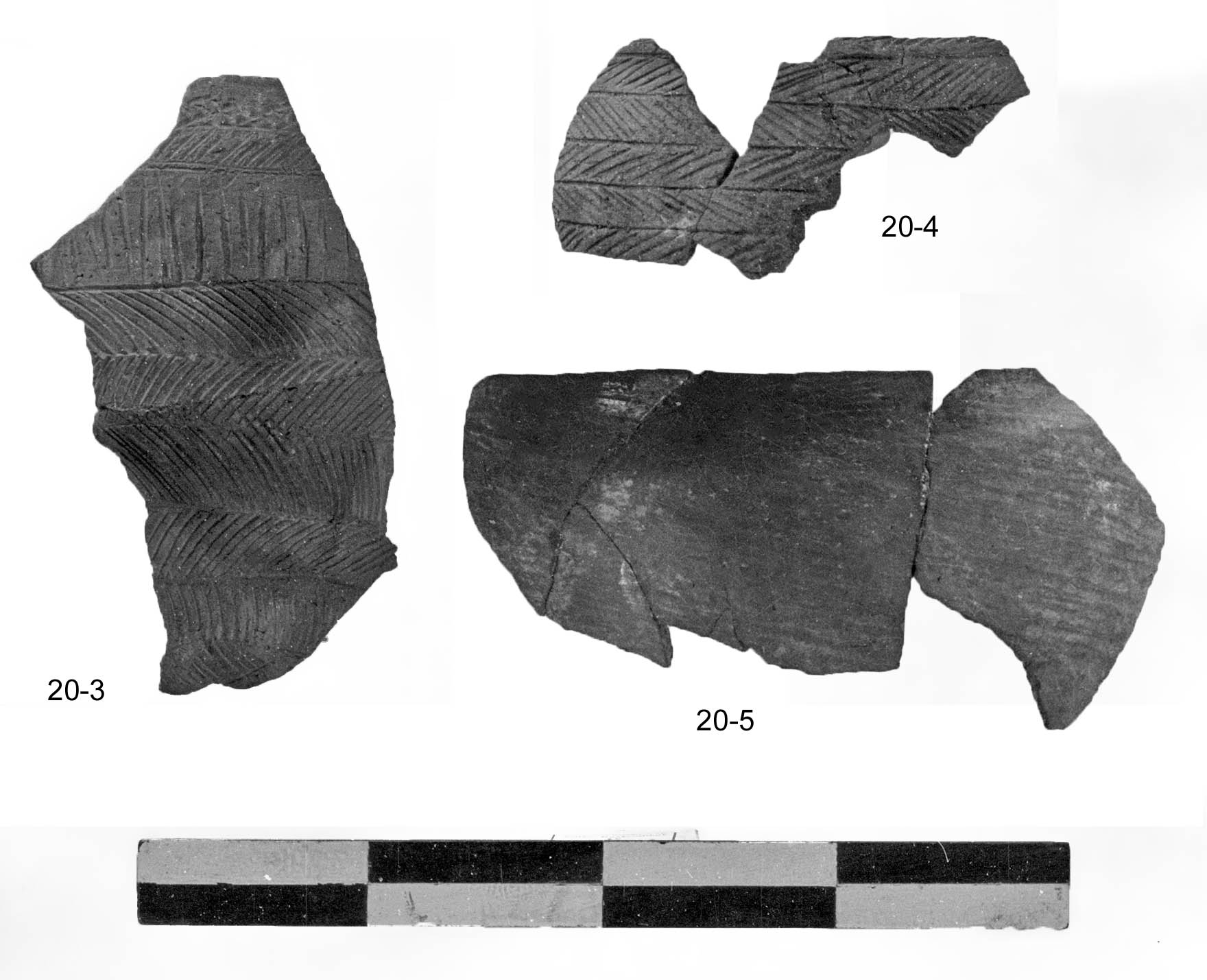
All the graves had been heavily disturbed and little of the burials survived. Some complete as well as more fragmentary pottery was recovered from the sand fills of the robbed graves. This includes some more common ‘C-Group’ types as well as some with more unusual decoration. Some groups of pottery from different graves are illustrated below.


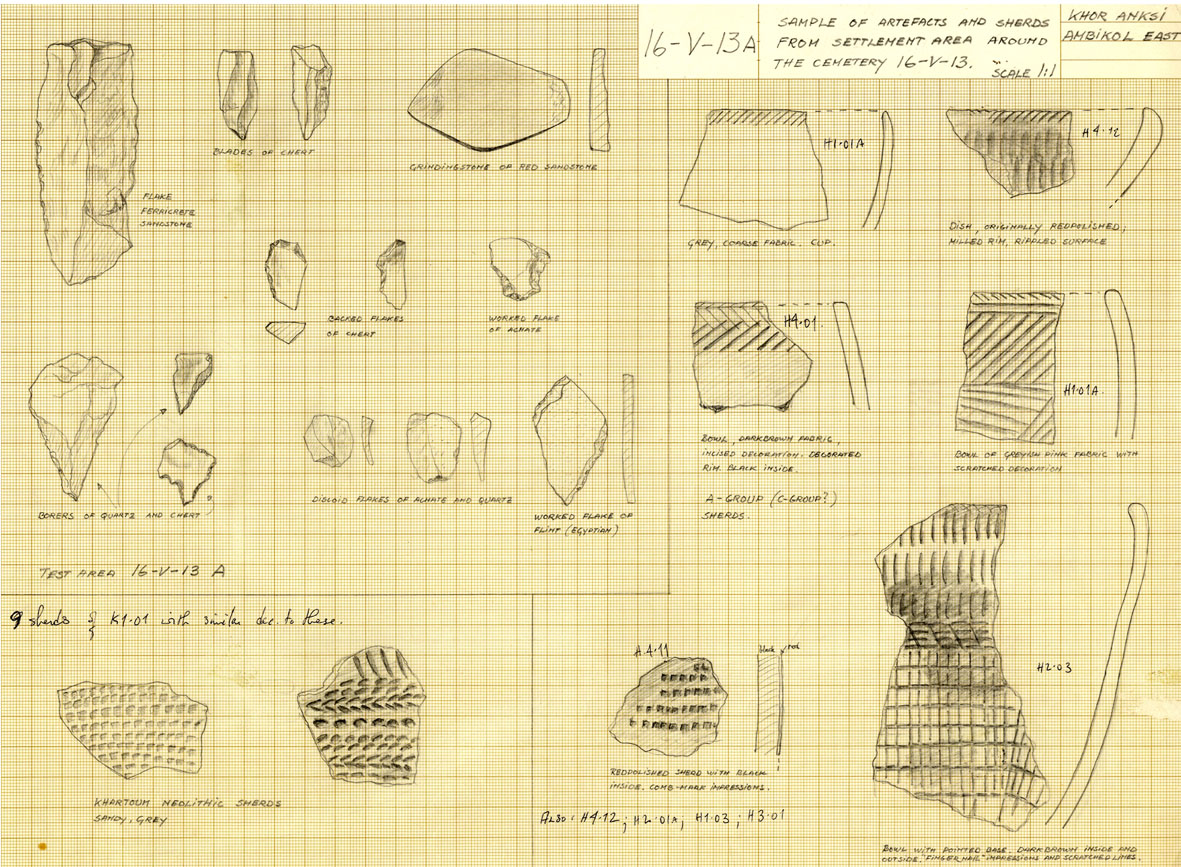
During the excavation is was noted that the graves overlay an area of older settlement. A test area of 25m x 25m was cleared, confirming that all the finds were confined to the surface layers of sand over fossil silt and rock. A mixture of sherds of potentially different periods (?) were found as well as some lithics of chert, agate, ferricrete sandstone, quartz and (?Egyptian) flint. The site was not separately registered as thought mixed/disturbed, but a small sample of mateaial was recorded (see below). This included some distinctive Mesolithic pottery (ware K1.01).
 ASSN 1963-1969